Facebook Ad Examples That Actually Sold (and Why)
The best Facebook ad examples all share one trait: the first line is about the reader, not the brand. Everything else — the image, the offer, the button — only gets a chance if that first line stops the scroll. Below are seven example ad patterns that sell, each shown as a weak version and a stronger rewrite, with the reason it works scored the way a media buyer would score it. These are illustrative teardowns, not brand case studies, so you can copy the pattern onto your own ad.
Want the same critique on your actual ad instead of an example? Paste it into the free roast and get a Butter Score in about twenty seconds.
How I'm judging each example
Every example is scored on the same four things, each out of 25 — the Butter Score rubric:
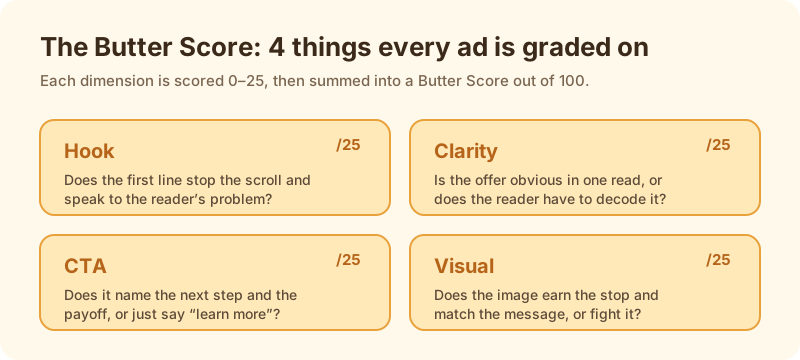
- Hook — does the first line stop the scroll and name the reader's problem?
- Clarity — is the offer obvious in one read?
- CTA — does it name the next step and the payoff?
- Visual — does the image earn the stop and match the message?
1. The problem-first hook (local gym)
Weak: "Iron Peak Fitness — New Year, New You. State-of-the-art equipment and certified trainers."
Stronger: "Tired of paying for a gym you visited twice in January? Here's how our members actually keep showing up in March."
The weak version opens with the brand and lists features. The strong version names a specific, slightly embarrassing situation the reader recognizes instantly. Hook goes from a scroll-past to a scroll-stop because the reader sees themselves in the first seven words.
2. The one-promise offer (meal kit)
Weak: "Fresh ingredients, chef-designed recipes, flexible plans, and free delivery."
Stronger: "Dinner solved in 20 minutes, three nights a week, without a single trip to the store."
A feature list asks the reader to imagine why any of it matters. A single concrete promise does that work for them. The strong version wins on clarity — one read and you know exactly what you're getting and what changes in your life.
3. The honest CTA (SaaS free trial)
Weak: "Learn more about our platform."
Stronger: "Start a project free — you'll have your first report built in five minutes."
"Learn more" hides what happens after the click. The strong CTA names the next step and the payoff in the same breath, so the click feels safe. This is one of the highest-impact single-line fixes in any Facebook ad example you'll find.
4. The specific-number proof (bookkeeping service)
Weak: "We help small businesses save money on taxes."
Stronger: "Most of our clients find $4,000–$9,000 in deductions they were missing — in the first review."
Vague claims are invisible; specific ranges are believable. Note the range rather than a single suspiciously-round number — it reads as real. Only use a line like this if it's actually true for your business; never invent the figure.
5. The pattern-interrupt visual (skincare)
Weak: A polished product-on-white photo that looks like every other skincare ad.
Stronger: A close, slightly unglamorous before-and-after on a real face, shot on a phone.
The over-produced image blends into the feed; the slightly raw one looks like a friend's post and earns the stop. The visual scores high not because it's pretty but because it interrupts. Matching message to image is what the visual dimension measures.
6. The objection-led hook (online course)
Weak: "Enroll in our complete digital marketing masterclass today."
Stronger: "You don't need another 40-hour course you'll never finish. Here's the one-week version."
Leading with the reader's real objection — "I've bought courses before and didn't finish" — disarms it before it kills the sale. This pattern works because it says the thing the skeptical reader is already thinking.
7. The named-audience hook (B2B tool)
Weak: "Boost your team's productivity with our all-in-one solution."
Stronger: "If you're an agency owner still tracking client work in spreadsheets, this is going to sting a little."
"Boost your team's productivity" could be for anyone, which means it's for no one. Calling out one exact audience — agency owners on spreadsheets — makes the right person feel personally addressed and lets everyone else scroll past, which is fine.
What all the strong examples have in common
Look back across the seven. Every stronger version does at least two of these:
- Opens with the reader's situation, not the brand.
- Makes one specific promise instead of listing features.
- Uses a CTA that names the payoff.
- Earns the stop with a visual that matches the message.
None of them are clever. They're specific. Specificity is the whole game — it's what makes a claim believable and a scroll stop.
How to turn these examples into your ad
Pick the pattern closest to your offer, write your version, then score it before you spend. Run it through the free roast to see your hook, clarity, CTA, and visual scores, plus a rewrite of your weakest line. If you're testing several angles at once, Butter Pro gives you unlimited roasts and rewrites of every line, with score tracking so you can see which example pattern actually lifts your ad.
Frequently asked questions
Where can I find real Facebook ad examples to study? Meta's Ad Library shows live ads from any advertiser — a great place to study competitors. But seeing an ad isn't the same as knowing why it works; that's what the scoring rubric above is for.
What makes a Facebook ad example "good"? A good example stops the scroll with a reader-first hook, makes one clear promise, and tells you exactly what to do next. If you can delete the brand name and the first line still reads like your customer's own thought, it's a strong hook.
Should I copy a competitor's ad? Copy the pattern, never the words. The patterns above are reusable; the exact copy has to be specific to your offer or it goes vague and stops working.
How do I know if my rewrite is actually better? Score both versions. A rewrite that raises your hook and clarity numbers is better; one that only feels better usually isn't. Roast both and compare.
The short version
The Facebook ad examples that sell aren't the flashy ones — they're the specific ones. Reader-first hook, one real promise, an honest CTA, a visual that matches. Pick a pattern above, write your version, and roast it free before you boost it.
Related reading: why your Facebook ads aren't working and Roast My Ad — how the free critique works.
Your turn.
Paste your ad (or screenshot it) and get a brutal Butter Score in 20 seconds. Free.
🔥 Roast my ad free →